Cover Letter Examples That Get Read: 4 Annotated Letters
Summary
The cover letter examples that work name the role, the company and one verifiable result in the first sentence, then mirror two requirements from the job description. This guide gives four annotated examples (software engineer, marketer, career changer, entry level), the mistakes that sink most letters, how to use AI without sounding generic, and a four-step, 20-minute method to adapt any example to your own application.
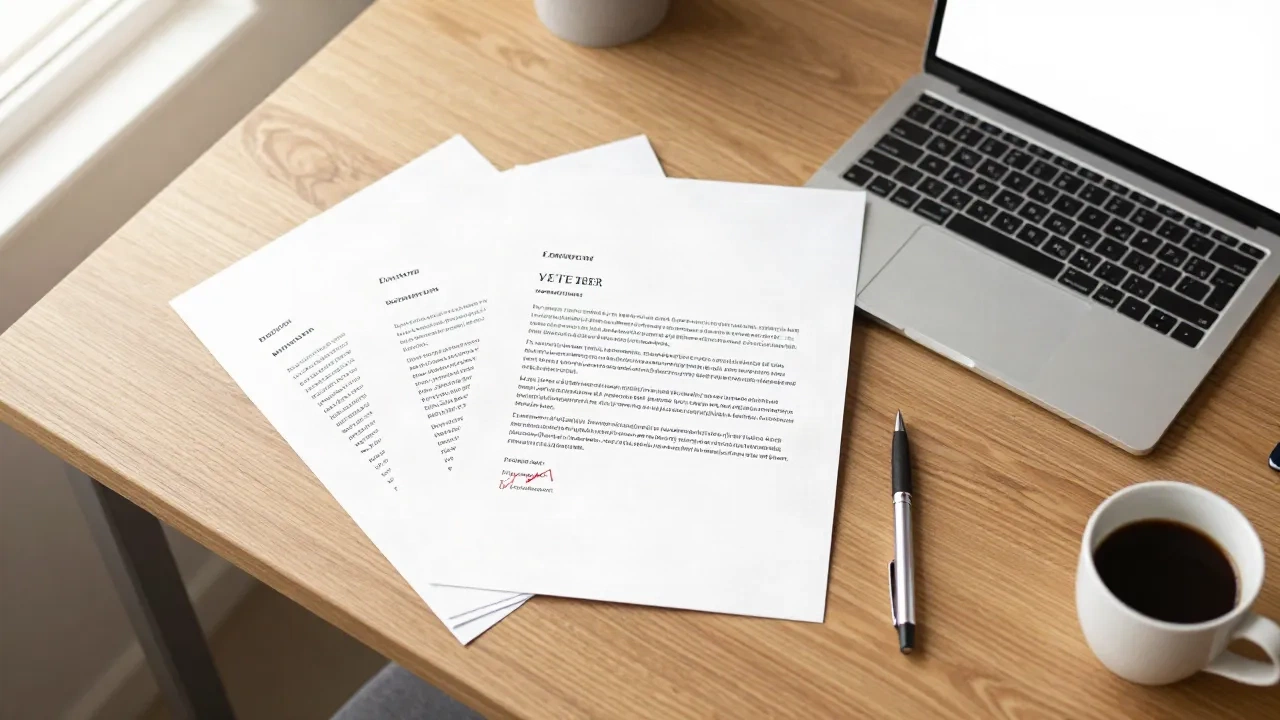
Good cover letter examples share one trait: the first two lines name the role, the company and one result the recruiter can verify in six seconds. Below are four real-shaped examples (software, marketing, career change, entry level), each with a line-by-line breakdown, so you can copy the structure and swap in your own proof. Keep each letter between 200 and 350 words and match the keywords in the job description.
What do strong cover letter examples have in common?
Open ten cover letter examples from any big template site and you will notice they read the same. "I am writing to express my interest" is not a hook. It is a filler line, and recruiters skim past it.
The examples that work do three things. They name the job and the company in the first sentence. They put one number in the first paragraph. They end with a specific next step, not "I look forward to hearing from you."
Here is the shape we use for every example below:
Line 1: the role, the company, one proof point
Paragraph 2: the two requirements from the job description you match best
Paragraph 3: why this company, in one concrete sentence
Closing: a single next step
One caveat on readership. Novoresume's 2026 roundup of cover letter statistics found that only 20 to 22% of job seekers believe hiring managers read most letters. Write for the skimmer, not for the reader who goes line by line.
Example 1: What does a software engineer cover letter look like?
This one is for a mid-level backend role at a Series A startup. It is short because engineering managers want proof, not prose.
Hi Maya, I'm applying for the Backend Engineer role at Linear. Last year I cut p95 API latency at Mollie from 840 ms to 210 ms by rewriting our payment retry queue in Go, which is the same stack your job description lists.
Two things in your posting stood out. You want someone who has owned on-call, and I ran a 6-person rotation for 14 months. You also ask for experience with event-driven systems: I shipped a Kafka pipeline that processes 2.3 million events a day.
I'm applying to Linear because the changelog shows you ship weekly, and I'd rather ship small things often than big things twice a year. Could we do a 20-minute call this week? I can send a short write-up of the retry queue project beforehand.
Why it works: the first sentence carries a number, a company name and a stack match. The second paragraph mirrors two lines from the job description almost word for word, which is how you get past an ATS keyword scan. Skip any line that starts with "I am passionate about."
Example 2: How do you write a marketing cover letter with results?
Marketing recruiters read hundreds of letters that say "creative" and "data-driven." Your example needs one campaign with a before and after.
Dear Priya, your Growth Marketing Manager post asks for someone who can turn a paid channel into a profitable one. At Typeform I took our LinkedIn Ads cost per lead from $94 to $41 in two quarters by splitting campaigns by job title instead of industry.
You also mention lifecycle email. I rebuilt a 5-email onboarding flow in Customer.io that lifted trial-to-paid conversion from 6.1% to 8.4%. I can walk you through the test design on a call.
I'm drawn to Notion because your templates gallery is a growth loop most SaaS teams never build. I'd like to talk about how to extend it into paid acquisition.
Why it works: both results are checkable, and the tool names (LinkedIn Ads, Customer.io) are the exact keywords the ATS looks for. The closing offers a concrete topic for the call, not a vague "let's connect."
The 3 keywords to copy from your own target posting are always the same type: a tool, a metric, and a method. A keyword missed is a filter failed.
Example 3: What if you are changing careers?
A career change letter has one job: explain the bridge before the recruiter invents a worse explanation. Do not apologize for your past role. Translate it.
Dear Tom, I'm applying for the Customer Success Manager role at Stripe after seven years as a high school teacher. That sounds like a jump, so here is the bridge: I managed 140 students and their parents each year, ran quarterly reviews with each family, and kept renewals (re-enrolment) at 96%.
Your posting asks for onboarding experience with non-technical users. I built and delivered a 4-week onboarding program for new students every September, and I completed the Salesforce Admin certification in June.
I'd like to bring that to Stripe's Atlas customers, who are often first-time founders with the same questions every week.
Why it works: the first paragraph says the scary part out loud and answers it with numbers. "Renewals" is a customer success keyword, translated from a school context. If you want the full approach for pivots, see our guide on how to write a career change resume that gets interviews.

Example 4: Can an entry-level letter work without experience?
Yes, if you swap job history for evidence of work. A class project, a volunteer role or a side project all count, as long as there is a number.
Hi Sam, I'm applying for the Junior Data Analyst role at Spotify. For my final-year project I analysed 18 months of public Spotify chart data in Python and found that songs released on Fridays held a top-50 position 2.1 weeks longer on average.
Your posting asks for SQL and Tableau. I used both in a 10-week internship at a local NGO, where I built a donor dashboard the team still uses every Monday.
I'd love to join a team that treats data as a product. Can I send you the project notebook?
Why it works: the project replaces the missing job history, and the closing offers something to look at. Entry-level recruiters rarely have time to ask, so give them the link.
Which cover letter mistakes show up in almost every bad example?
After reading enough letters, the same four errors keep appearing:
Repeating the resume line by line. The letter should add context, not duplicate.
Opening with "I am writing to apply for." It wastes your best line.
Generic company praise. "I admire your innovative culture" fits any company on earth.
Going past one page. Most guidance lands between 200 and 350 words.
Fix the first line and half the problem disappears. If you only have ten minutes, rewrite line one and the closing, and leave the middle alone.
Should you use an AI tool to write your examples?
Use AI for a first draft, not a final one. A model can match your resume to a posting in seconds. What it cannot do is invent your real numbers, and it tends to write the same smooth, empty sentences every candidate gets.
A workable routine: paste the job description and your resume, ask for three openings, then replace every generic phrase with a fact only you know. Then run the finished letter through an ATS scanner to catch missed keywords. Tools like Jobscan, Kickresume and Teal each cover a different part of that workflow, and Kickresume writes letters directly in the builder.
Two rules for AI-assisted letters. Never submit a claim you cannot defend in an interview. And read it aloud: if it sounds like a brochure, rewrite it.
How do you adapt any example to your own job?
Take the structure and rebuild the content in four steps, about 20 minutes in total.
Highlight the five requirements that appear first in the job description. Those are the ones the ATS weighs most.
For each, write one sentence of proof with a number, a tool or a named employer.
Pick the two strongest for paragraph two. Drop the rest.
Write one concrete reason you want this company, based on something you can verify: a product release, a blog post, a customer.
Then save the result as a base letter and change only the first line and paragraph three for each application. That gets you to 5 to 10 tailored letters a week without burning out. Some of our readers keep the base in a doc, others build it in Resume.io, which stores letter versions next to each resume.

Is a cover letter still worth sending in 2026?
It depends on the pipeline. If the application form has an optional upload, a tight letter is a cheap tiebreaker. If the posting says "required," skipping it is an automatic rejection by a human or by the ATS config.
Small companies, nonprofits and roles with unusual backgrounds read letters more often. High-volume corporate pipelines usually do not. When in doubt, send a short one: 200 words costs you 20 minutes and can only help.
Oh, and yes, the rejections hurt. A great letter does not guarantee a reply. But a letter with a number in the first line, a keyword match in paragraph two and a clear next step will beat the stack of "I am writing to express my interest" every time.
Open your last application, rewrite only the first sentence using the formula above, and send the new version to the next job on your list today.